.svg)


.svg)

.jpeg)


Quick Answer : What is a POS System? A POS (Point of Sale) system is hardware and software that allows businesses to accept payments, record sales, and manage operations from a single device.
A small café unlocks its doors and the morning rush begins. Customers stream in, orders pile up at the counter, and payments flow steadily, each transaction part of the daily rhythm that keeps a small business running. Behind the scenes, a POS system quietly ties it all together.
For businesses across the UAE, a reliable point-of-sale system isn't just a convenience, it's the backbone of daily operations.
In this guide, we'll break down exactly what a POS system is, how it works, and what to look for when choosing the right one for your business.
What Is a POS System?
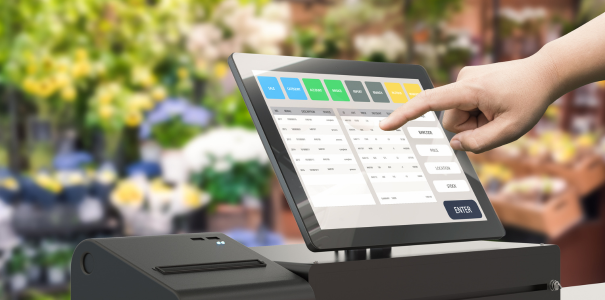
Behind every payment in a shop or café, there’s a system recording the sale. This system is known as a POS system. A Point of Sale system brings payments, orders, and sales data together in one place. It’s not just a payment device; it helps owners manage daily operations whether they run a restaurant, retail store, or salon.
In practical terms, it’s the combination of tools that allow a business to:
- take payments
- record sales
- issue receipts
- track products or orders
- generate reports
Instead of handling these tasks separately, a POS system brings them together into one workflow.
For example:
- a restaurant enters orders
- a retail store scans products
- a salon charges for services
All of these actions typically happen inside the POS system.
In short: A POS system is the operational hub where sales, payments, and business records meet.
POS System vs Card Machine
Many business owners assume a POS system and a card machine are the same thing, since both are used at the moment of payment. In reality, they serve different roles in daily business operations.
A card machine focuses on one task: processing a payment. A POS system records the transaction and connects it to the rest of the business workflow.
What a Card Machine Actually Does
A card machine in the UAE typically handles the payment itself. The customer taps or inserts their card, the transaction is approved, and the payment is completed.
In most cases it:
- processes card or contactless payments
- prints a receipt or sends a digital one
- records the payment amount
What it usually does not do is track what was sold or generate detailed business reports.
What a POS System Adds
A POS system goes beyond payment processing. It helps the business track what is happening during the day.
For example, it can:
- record the product or service sold
- generate VAT-ready receipts
- track sales throughout the day
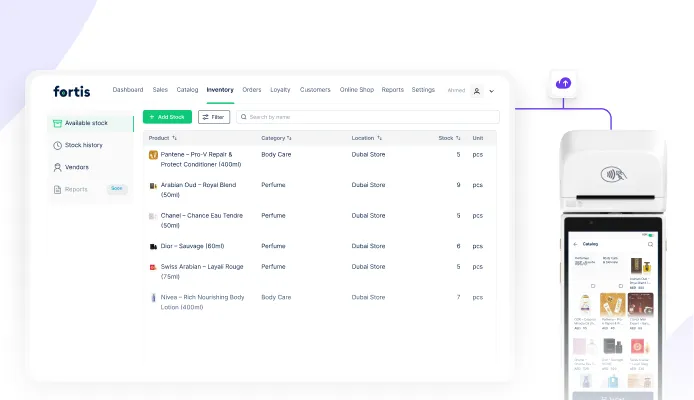
- update inventory levels
- create reports the owner can review later
Quick Comparison
Why Does the Difference Matters?
For very small setups, a card machine can be enough. But once a business starts managing multiple products, staff, or daily reporting, a POS system becomes more useful because it helps owners understand how the business is performing.
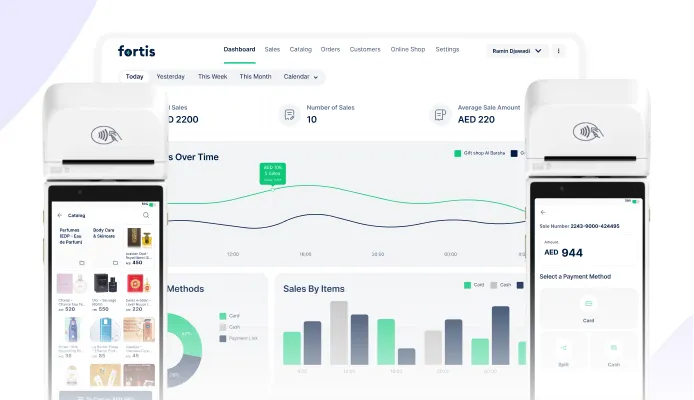
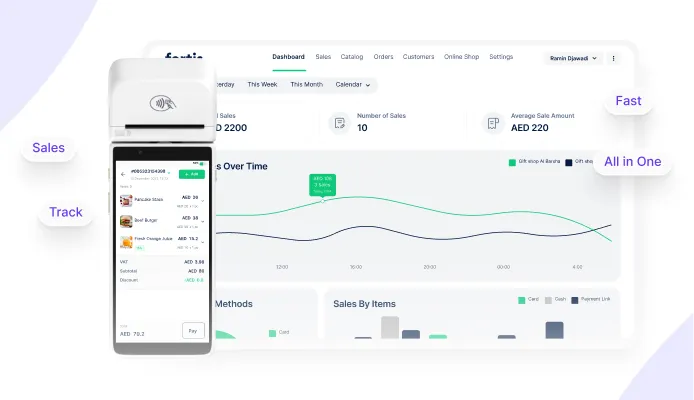
In many modern setups, the two tools are combined. Some devices now run POS software directly on the payment terminal, allowing businesses to manage sales and payments from a single device.
How a POS System Works in a Real Business
Let’s look at a simple example from a retail shop.
- A customer purchases something
- The staff adds the order into the POS system.
- The staff then takes payments on the card machine
- Prints the reciept and gives it to the customer
- The POS calculates the total and processes the payment.
- A receipt is generated and the sale is recorded in daily reports.
From the owner’s perspective, the same system now shows:
- total sales
- payment methods used
- popular menu items
- staff performance
Key Components of a POS System
A modern POS system usually includes three main parts.
1- POS Hardware
These are the physical devices used during transactions.
Common examples include:
- POS terminal or card machine
- tablet or touchscreen
- receipt printer
- barcode scanner
- kitchen display screens
2- POS Software
The software manages operations such as:
- sales tracking
- order management
- inventory monitoring
- employee permissions
- business reports
3- Payment Processing
This is the infrastructure that connects the POS system to payment networks.
It allows businesses to accept:
- credit cards
- debit cards
- mobile wallets
- contactless payments
In the UAE, POS systems increasingly support local payment initiatives as well. For example, the domestic card scheme Jaywan, launched in 2024 by the UAE Central Bank’s subsidiary Al Etihad Payments, is supported by over 90% of POS terminals in the country.
Types of POS Systems Used in the UAE
POS systems have evolved far beyond traditional cash registers. Today, businesses in the UAE typically encounter several types of POS setups.
These ranges reflect average POS system prices in the UAE market and may vary depending on the provider and features. Some local solutions, such as Fortis SmartPOS, offer annual subscription plans starting below AED 1,000 per year, which is significantly lower than traditional hardware setups.
For example, the SmartPOS price with Fortis is offered through a subscription model that runs the POS software directly on the payment terminal.
You’ll also see self-service kiosks in some larger restaurants and quick-service chains, where customers can order and pay on their own.
Popular POS Systems in the UAE: A Quick Comparison
Choosing a POS system in the UAE comes down to what your business already has, how much you want to spend, and whether you need a local support team when something goes wrong. Below is a side-by-side look at four systems that regularly come up in the UAE market, compared across the factors that matter most to small and mid-sized businesses.
What this means for UAE SMEs
Most systems on this list require separate hardware on top of the monthly fee. Fortis SmartPOS is the only option here that runs on a Network International card machine you may already have, with loyalty and reporting included at AED 990/year and no add-on fees.
- Foodics and Sapaad suit restaurants needing kitchen management or delivery integrations.
- Lightspeed works well for multi-location retail but has no dedicated UAE support team.
How Some POS Systems Work Without Buying New Hardware
Many business owners assume a POS system requires several new devices. Traditionally, businesses would install a POS terminal, card reader, and receipt printer to manage sales and payments.
This idea has driven newer SmartPOS models in the UAE. Fortis was built in 2022 around the same concept: turning existing Network International card machines into full POS systems without requiring merchants to purchase new hardware.
Newer POS setups simplify this by allowing the payment terminal itself to run the POS software. This means the same device can handle tasks such as:
- recording sales
- managing products or services
- generating receipts
- tracking daily reports
In some setups, the payment device itself becomes the central tool for both payments and sales management. Instead of relying on separate systems, businesses can process transactions and record orders from the same terminal.
For small businesses, this usually means fewer devices on the counter and a simpler checkout setup to manage day to day. Fortis SmartPOS is built on exactly this principle. It runs directly on your existing Network International card machine, turning it into a full POS system without any additional hardware investment.
Average POS System Cost in the UAE
POS system costs vary depending on several factors.
The main cost components are:
Hardware
POS terminals typically cost between:
AED 1,500 and AED 4,000 per device
depending on brand, features, and peripherals.
Software
POS software subscriptions often range from:
AED 150 to AED 400 per month
for small business plans.
Processing Fees
Payment providers may charge transaction fees, often between:
1.5% and 3% per card transaction
depending on the provider and card type.
Many owners researching POS system price in Dubai quickly realize that the final cost depends on the number of devices, software subscriptions, and payment processing agreements required for their business.
Why UAE Businesses Use POS Systems?
Running a business in the UAE today means handling a mix of payment methods, from cards and mobile wallets to cash. A POS system brings all of these together in one place, ensuring every transaction is recorded, tracked, and reported accurately regardless of how the customer chooses to pay.
Over time, it also shows you patterns you would not notice otherwise:
- Which customers keep coming back
- What sells and what sits
- Which offers are worth running again
That kind of insight turns everyday sales data into smarter decisions on pricing, inventory, and offers.
What POS Features UAE Businesses Should Look For
Once a POS system is part of your setup, you end up using it all day. If it doesn’t fit how your business works, even basic tasks at checkout can start slowing things down.
At the very least, it should handle cards, mobile wallets, and contactless payments smoothly. In the UAE, it’s also worth confirming Jaywan support. Clear daily reports help you track sales and stay on top of VAT.
Beyond that, a few features can make running things much easier:
Easy for staff to use
Your team shouldn’t need a manual to figure it out. If it takes too long to learn, it will slow things down during a busy shift.
Integrations
The POS should connect with tools your business already relies on, such as delivery platforms, accounting software, or reservation systems.
Security
Look for systems that follow PCI DSS standards to keep card payments secure.
Offline capability
In busy environments such as events or outdoor markets, internet connectivity may not always be stable. Some POS systems allow transactions to continue offline and sync automatically once the connection is restored.
Staff management
Some POS platforms allow managers to track shifts and control user permissions, which helps maintain better oversight of daily activity.
VAT compliance
In the UAE, businesses generating more than AED 375,000 in annual revenue must register for VAT under Federal Decree-Law No. 8 of 2017. A POS system should help generate VAT-ready reports and maintain clear transaction records for Federal Tax Authority (FTA) filings.
Choosing the Right POS System: Quick Evaluation Checklist
When you’re deciding on a POS system in the UAE, a few simple checks can help you see if it will actually work for your business.
For many business owners, reviewing these factors helps narrow down the right POS system setup and avoid costly system changes later.
Conclusion
At the end of the day, most business owners just want things to run smoothly. Orders go in, payments go through, and the numbers make sense when the day closes.
That’s exactly what a good POS system should do. Nothing complicated, just one place to manage sales and payments.
If you’re thinking about upgrading your setup, Fortis SmartPOS lets you get started in minutes with no new hardware and no IT setup, using your existing card machine and a subscription starting from AED 990 per year.
FAQ
Q1: Does a POS machine require internet?
Most POS systems can continue recording transactions even if the internet connection drops. The system stores the data locally and automatically syncs once connectivity is restored.
Q2:How much does a POS system cost UAE?
Costs vary depending on hardware and software. Small businesses typically spend AED 1,500–4,000 for terminals and AED 150–400 per month for software subscriptions.
Q3:Is a POS machine required in Dubai?
Many businesses use POS machines because customers increasingly expect card or mobile wallet payments. In sectors like retail and hospitality, POS systems are now considered standard operational infrastructure.
Q4: How does a POS system help with VAT reporting in the UAE?
A VAT-compliant POS automatically calculates the 5% VAT on every transaction and generates a period-end report showing your total sales and VAT collected, which is exactly what you need to file with the FTA.
Q5: What is the most affordable POS system in the UAE?
POS system pricing varies depending on hardware and software. Some modern SmartPOS solutions allow businesses to run POS software directly on existing payment terminals through a yearly subscription, reducing the need for traditional POS hardware.