.svg)


.svg)




The UAE food truck services market is currently valued at USD 1.2 billion, with over 1,500 registered food trucks operating across the country. The level of competition only tells how important it is to have the right operational setup, including your payment and ordering system, one of the clearest ways to stand out.
However, if you search for Food Truck POS UAE, the search terms would often give you results for restaurant POS systems. If you have a big, fancy restaurant, that is fine but if you only have a food truck then, you don't need a complete restaurant POS system with features that you would barely use.
A restaurant has a fixed counter, a backroom, and staff who do not move much. You have a serving window, a generator, and two people doing five jobs at once. The iPad-on-a-stand setup that a cafe in JBR uses is not going to work for you at a Friday market in Al Quoz, and buying into that assumption is how food truck operators end up with equipment that creates friction instead of removing it.
This guide is about what actually works in the UAE food truck operations, not what exists on the market, not what the brochures say. What works. If you are comparing options right now, this will help you narrow down what is actually worth using.
What POS systems do Food trucks need?
Food trucks need a setup that is meant for food trucks, not a scaled-down version of a restaurant system. Space, speed, and portability should drive the decision. Here are some things you need to be mindful of:
- A practical setup has three layers: payment acceptance, order management، and mobility. Also, you need to keep in mind the space requirements.
- In the UAE, most food truck operators accept card, cash, and contactless payments. Your Food truck POS should log all three in the same place.
- Connectivity matters outdoors. Ask any POS provider how their system behaves during a signal drop before committing to a setup for UAE markets and events.
Why Food Truck POS Is Its Own Category?
The honest reason most food truck setups fail is that operators borrow the logic from restaurant POS buying without adjusting for the constraints they are actually dealing with.
Counter space is the obvious one. A serving window is not a reception desk. Once you put a card terminal on the ledge and leave room for packaging, there is not much left. Adding a tablet stand and a receipt printer on top of that means something has to go, and usually it is the practical flow of your service.
Then there is setup time. If you are pitching at a weekend market or an event, you are probably setting up from scratch each time. A system that takes 20 minutes to configure and pair before service is not viable when you have 40 minutes total before the gates open.
Speed is the other factor. A table-service restaurant can afford a slightly slower checkout because the customer is seated. Queue management at an outdoor market is different. If the payment step takes more than 15 seconds, the line backs up and customers leave.
None of this is complicated. But it does mean the criteria for choosing a food truck POS in the UAE are meaningfully different from what you would use for a fixed F&B location.
Three Must Haves Features in a Food Truck POS
Forget features lists for a moment. A food truck POS setup in the UAE, first and foremost should be mobile and not take up your entire food truck space. On top of it, it needs to accept payments, help you manage orders easily and keep the line moving without customers being frustrated. Here are the three important features you need to have in your Food truck POS.
- Take all types of payments without friction
In the UAE, most people don't carry cash anymore, which is why it is important that your Food truck POS system can accept Apple Pay, Google Pay, and even digital wallets. Moreover, contactless is now the default for most UAE customers, especially at markets and events, particularly for typical food truck transaction values. Chip-and-PIN still happens, but if your device is slow on NFC reads, you will notice it within the first busy hour.
- Menu management
Your menu is rarely fixed. Ingredient availability changes, you run seasonal specials, and the event you are attending might call for a smaller version of your usual menu. Managing these changes by hand, through a printed menu or a verbal update to staff, slows you down and creates room for mistakes during a busy service.
A POS with menu management built in lets you add limited-time specials, adjust prices, or update item descriptions directly from your dashboard, with changes appearing on the device in minutes. Your staff always work from the current menu, and customers are not offered something you cannot actually serve that day.
Menu management matters the most during peak hours. Instead of relying on a printed menu that goes out of date the moment you swap a special, or telling each staff member about a change individually, the update happens once and reaches every device at the same time. That means fewer mistakes at the counter and a faster line. You can also place a QR code to let customers easily access your menu
- Reliable offline mode with auto-sync
Food trucks often operate at festivals, parks, or remote event sites where cell signals can be weak or nonexistent. A POS that can keep processing orders and card payments offline (then sync sales data once connectivity returns) prevents you from being stuck unable to take payments during your busiest hours.
- Customer Loyalty Features
As a food truck, you will depend on repeat customers more than most F&B businesses. Whether it is office workers grabbing lunch every week or regulars who track down your truck across different locations, getting customers to come back is one of the biggest levers you have for steady revenue.
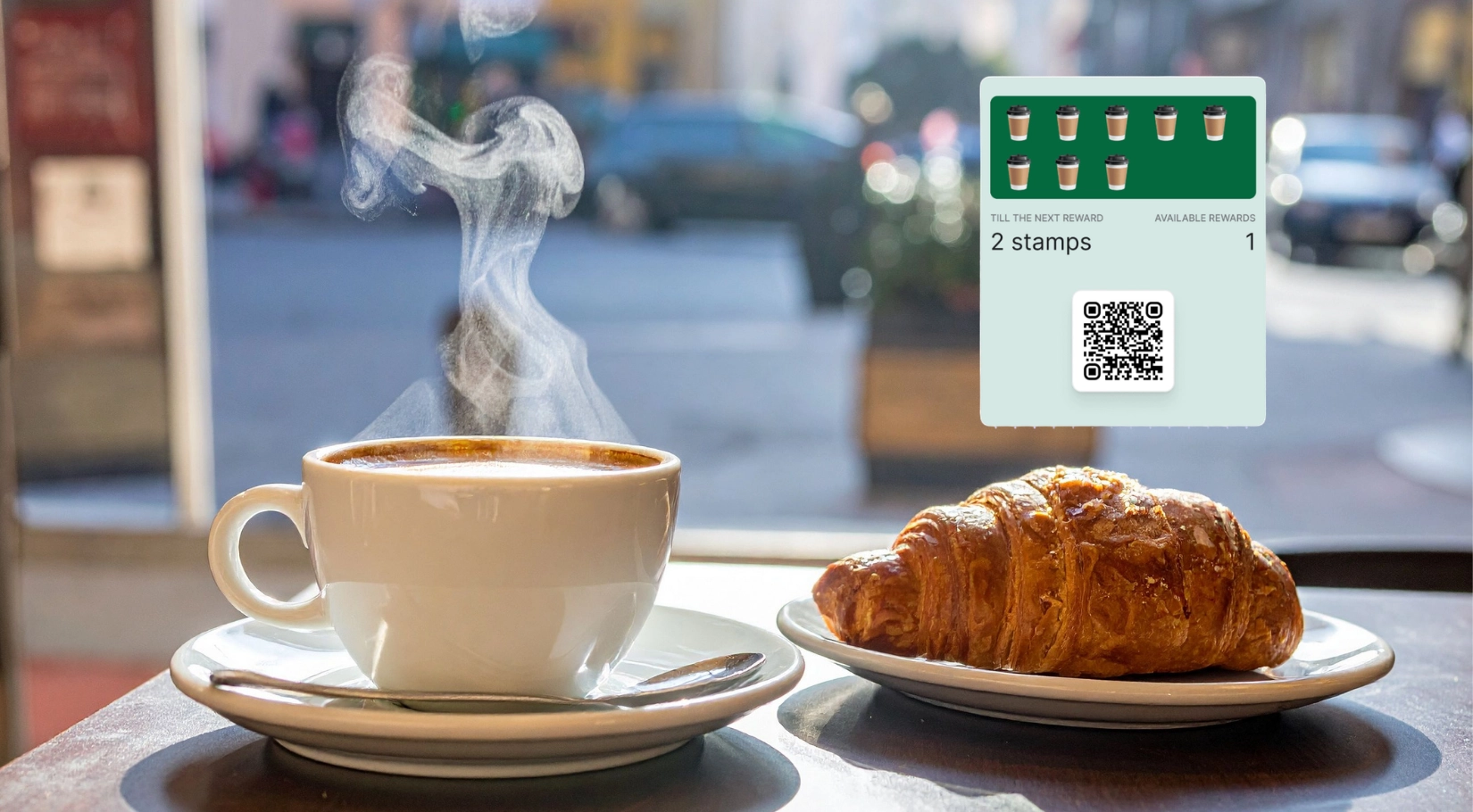
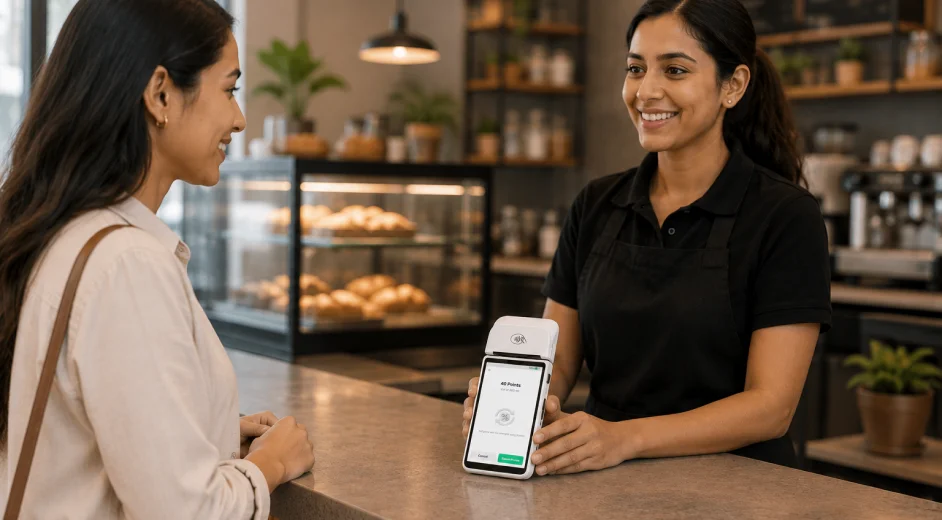
A POS with loyalty built in makes this easy. Instead of paper punch cards or manually tracking who comes back, you should consider a POS that helps you launch a digital loyalty program, so you can register customers by entering their phone number at checkout, and let them earn points or stamps automatically every time they pay.
Why SmartPOS is a Better Choice as a Food Truck POS
Given the fact that a food truck comes with limited space and has completely different operations than a full-fledged restaurant, you can consider using a smartPOS.
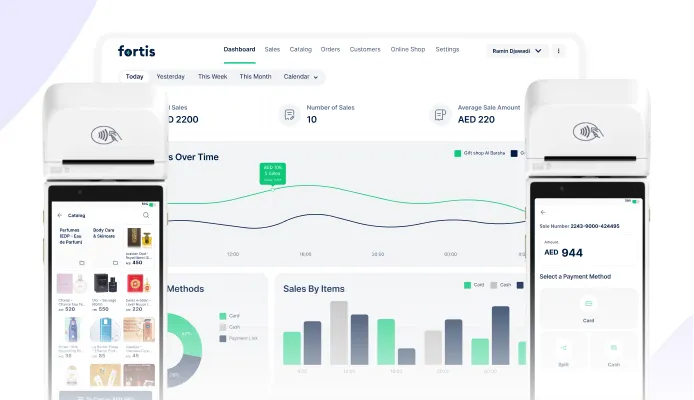
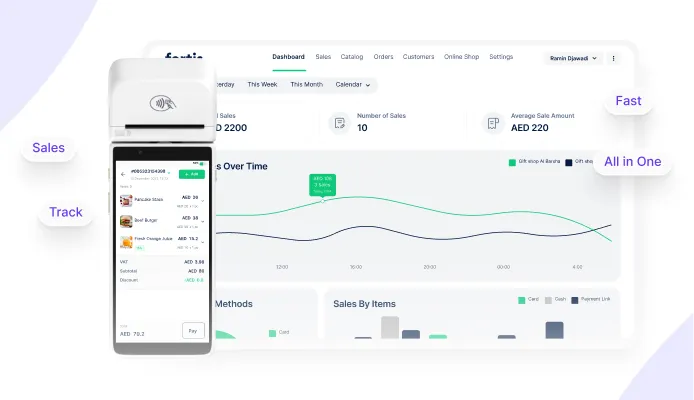
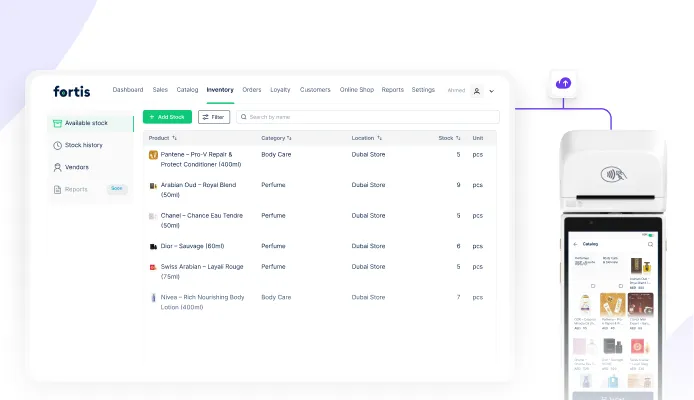
A SmartPOS such as Fortis SmartPOS is not a run down version of a restaurant POS, rather it can be the best choice for a food truck. A smartPOS basically converts your card machine into a complete POS solution, so you can do everything right from your card machine and manage your business online.
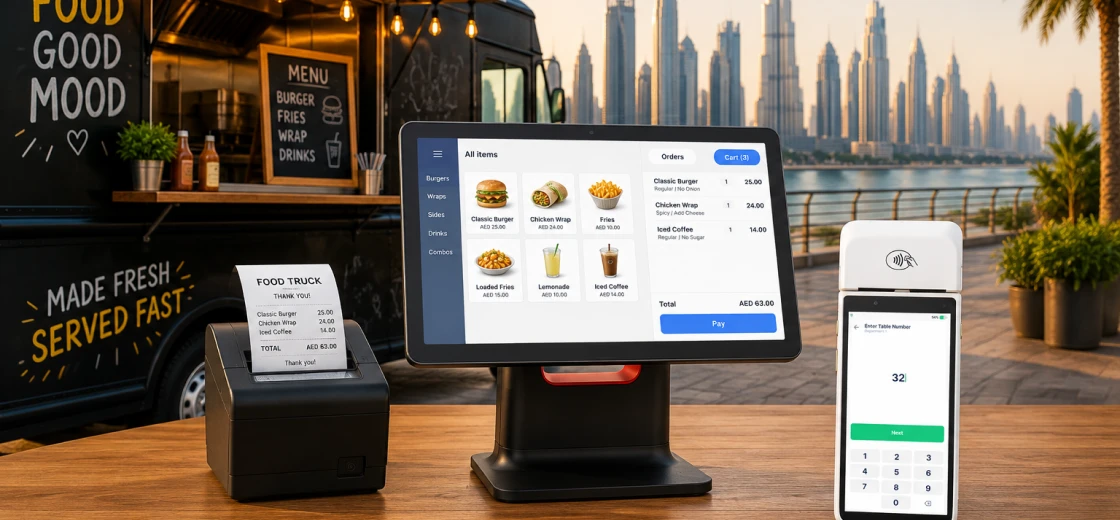
The card machine doubles as the order screen, the payment terminal, and the sales log, so orders, payments, and reporting all happen in the same place instead of across separate tools. It accepts card, cash, and digital wallets like Apple Pay and Google Pay, which means no customer is turned away because their preferred payment method is not supported.
The menu or catalog lives on the device itself, so updates to prices, items, or specials can happen in minutes rather than requiring a separate system or a printed menu. It also runs on its own mobile connectivity, which matters since most outdoor markets and events cannot guarantee a stable WiFi connection.
The best example here would be of Filli. When Filli placed its food truck in the Dubai Fitness Challenge, it used Fortis SmartPOS. The SmartPOS allowed Filli to accept card and even cash payments during the event. Plus, the menu was right there on the card machine, which allowed the staff to take orders not only at the food truck but nearby as well.
Traditional POS vs SmartPOS: What the Difference Looks Like in Practice
The table below compares a conventional tablet-based POS setup with a SmartPOS approach where the card machine itself runs the POS software. Both are valid for the right context. For most food trucks in the UAE, the differences matter.
One POS Device or Two: How to Decide
Most food trucks in the UAE operate efficiently with a single device.
One device is enough if your menu is limited, one staff member handles both orders and payments, and your transaction volume is moderate.
A second device becomes useful when transaction volume increases significantly or when your setup separates order-taking and payment physically. This can happen in drive-through configurations or larger setups.
For multi-truck operations, each truck operates independently but feeds into a single reporting dashboard, allowing performance tracking across locations.
Food Truck POS Checklist: Questions to Ask Before You Buy
Before choosing a food truck POS in the UAE, ask these questions:
- Can it accept card, cash, Apple Pay, Google Pay, and contactless payments?
- Does it work without a WiFi connection?
- Can I update menu items and prices instantly?
- How much space does the setup require?
- Can staff take orders away from the serving window?
- Does it include customer loyalty features?
- Can I see sales reports remotely?
- What happens if connectivity drops during an event?
- How long does setup take before service?
- Do I need additional hardware such as tablets, printers, or cash registers?
Mistakes To Avoid When Purchasing a Food Truck POS
Some mistakes may seem minor when setting up your payment system, but during service they can lead to order delays, congestion at the counter, and errors in your end-of-day reports. It is better to address these points early before committing to any setup:
- Buying a POS before confirming compatibility with the approved payment network. Network International is the primary payment network in the UAE, operating under the Central Bank's retail payment services framework, and compatibility should be confirmed early.
- Using consumer payment apps instead of a POS system. These lack catalog management, cash tracking, and reporting.
- Building a setup that depends entirely on stable connectivity. Systems should handle short signal interruptions without failing transactions.
- Not logging cash transactions in the same system. This leads to inaccurate reporting.
- Adding unnecessary hardware too early. Start with a minimal setup and expand only after identifying real operational gaps.
Pre-Launch Checklist
- Confirm your terminal is compatible with your POS software
- Upload your full product catalog with prices and variations
- Run a test card and cash transaction
- Ensure dashboard access from your phone
- Check device battery life for your full service window
- Understand how the system behaves during connectivity drops
- Set up a cash handling process
- Test any advance payment flows if used
- Run and verify an end-of-day report
The Best Food Truck POS Is the One That Gets Out of the Way
As a food truck operator, you do not need more hardware; you need fewer things to manage.
The right POS should help you take orders quickly, accept every payment method your customers use, update menus in minutes, and keep sales moving whether you are parked at a market, festival, or corporate event.
When evaluating Food Truck POS options in the UAE, focus less on feature lists and more on practicality. If a system saves space, reduces setup time, and helps you serve more customers during busy periods, it is probably the right fit for a food truck business.
At the end of the day, the best POS is the one that lets you focus on serving great food instead of managing technology.
FAQ
What is the best POS system for food trucks in the UAE?
For most operators, a SmartPOS-enabled terminal provides the simplest and most practical setup, combining payments and order management in one device.
Do I need an iPad to run a food truck POS?
No. A single device that handles both orders and payments is often more efficient in limited-space environments.
Can a card machine function as a full POS?
Yes, when running POS software, a card machine can handle orders, payments, and reporting within one system.
How does contactless payment work for food trucks in the UAE?
Terminals support tap-to-pay cards, Apple Pay, and Google Pay. Most transactions fall within contactless limits, making the process fast and efficient.
What is the simplest food truck POS setup?
A single terminal running POS software, with a loaded product catalog and integrated payment handling, is sufficient for most food truck operations in the UAE