.svg)


.svg)




.png)
For many small businesses in the UAE whether it is a specialty café or a neighborhood retail store, getting people through the door isn’t the hardest part. The real challenge is getting them to come back again and again, instead of trying a new place next time.
One way to increase repeat customers is through a loyalty program. When designed well, a loyalty program is one of the most effective and affordable ways to increase repeat visits, improve customer retention, and boost revenue without relying on heavy discounts
In this article, we’ll walk through what is a loyalty program and how you can easily launch one for your business.
What is a Loyalty Program?
A loyalty program is a way to reward customers for coming back to your business instead of treating every visit like it’s their first.
Think of it as a system that remembers your customers and gives them a reason to choose you again. Every time a customer buys from you, the loyalty program tracks that visit or spend and offers something in return such as a free item or discount after customers reach a certain point.
For example:
- A café might give a free coffee after 9 visits.
- A salon might give AED 50 off after a customer spends AED 500.
- A restaurant might offer cashback that customers can use on their next bill.
The goal isn’t to give things away for free. The goal is to turn one-time visitors into repeat customers and repeat customers into loyal fans. When customers know they’re getting closer to a reward every time they come to you, they’re more likely to return sooner and spend a little more.
Why Loyalty Programs Matter for Small Businesses in the UAE?
Loyalty programs are quite famous in the UAE. Loyalty programs market is expected to reach $819 million by 2029. So, if you are a small business in the UAE, here is how launching a loyalty program can help you:
1. They help customers choose you more often
In areas like Dubai Marina, Business Bay, Deira, or busy malls, customers are spoiled for choice. A café, restaurant, or store is often just a few steps away from the next one. When everything else feels similar — location, pricing, convenience — loyalty becomes the deciding factor.
If customers know they earn rewards every time they visit you, they’re far more likely to choose your business over the one next door. Even a small, predictable benefit creates a habit: “I’ll go there because my points add up.” Over time, this simple incentive quietly shifts behavior in your favor.
This matters even more for high-frequency purchases, where customers make quick, repeat decisions without much thought such as:
- Daily coffee runs
- Office lunches
- Snacks and pastries
- Everyday retail items
2. They increase revenue not just give discounts
A well-designed loyalty program isn’t about giving away money. It’s about changing customer behavior:
- Customers come back sooner
- They’re more likely to add “just one more item”
- They stick with you instead of switching
Even small incentives can shift habits, especially when customers clearly see their progress.
3. They open a direct communication channel
Once a customer joins your loyalty program, you have:
- A way to identify them
- A reason to communicate (rewards, offers, news)
- A context for personalized campaigns
A loyalty program gives you much more targeted audience than shouting into social media and hoping the algorithm shows your posts.
4. They turn anonymous walk-ins into known customers
Without loyalty, most SMEs don’t know:
- Who their customers are
- How often they visit
- What they typically buy
Loyalty programs change that, especially when they’re digital and connected to your sales system. You start seeing patterns and can make decisions based on real behavior, not guesses.
Main Types of Loyalty Programs for SMEs in UAE
Based on how cafés and small retailers in the UAE operate, the two most practical and widely used mechanics are:
1. Stamp-Based Programs
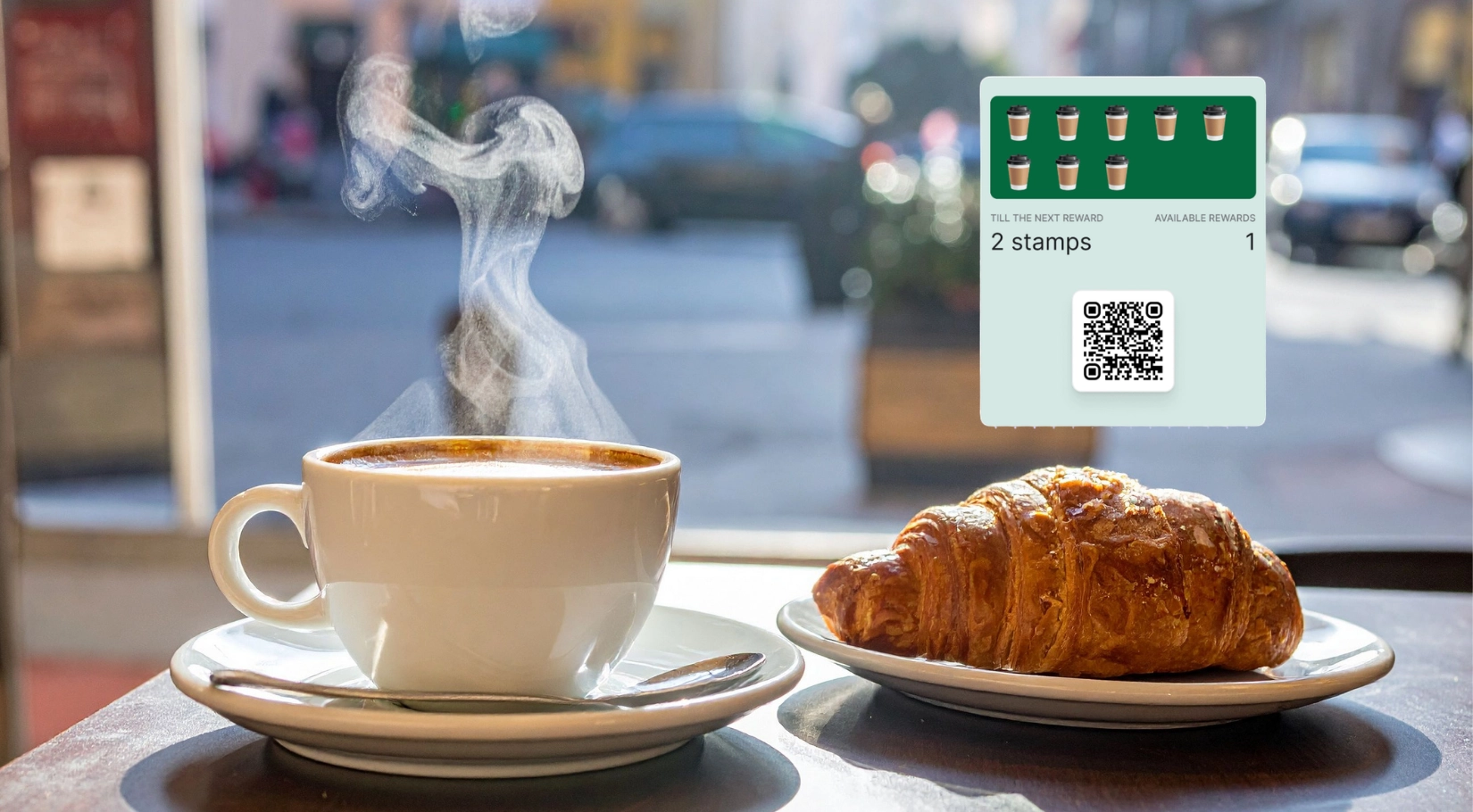
A stamp-based program allows customers to earn stamps each time they make a purchase. After they have collected a certain amount of stamps, they get a free reward. It is the simplest and most familiar mechanic, especially in F&B.
Examples:
- Buy 9 coffees, get the 10th free
- Buy 5 sandwiches, get a free drink
- Buy 7 desserts, get the next one on us
Why it works:
- Easy to explain at the counter in 5 seconds
- Customers see their progress visually
- Works best when the product and price are fairly consistent (e.g. coffee, scoops of ice cream)
Best suited for:
- Coffee shops
- Bakeries and dessert places
- Juice bars
- Fast casual snack concepts
2. Points Based Program
Points based loyalty programs are quite common in the UAE such as Shukran and Aura. However, these programs are not meant for large retailers only. As a small business, you can also launch your point based program.
In this program, customers earn a monetary balance with each purchase, displayed as points, which they can later spend this balance to pay for future orders.
As a best practice, 1 point should be equal to AED 1.
Let’s say you define:
- Earn rate: 5% of bill amount
- Conversion: 1 point = 1 AED
Example:
- Customer spends AED 80
- They earn 4 points
- Because 1 point = 1 AED, they now have AED 4 in their loyalty “wallet”
Next visit:
- Their bill is AED 35
- They decide to redeem all 4 points
- They pay AED 31 in cash/card + 4 points
Explaining this to customers is very simple:
“For every purchase, you earn points —
1 point equals 1 dirham, and you can pay with them next time.”
Why does a point-based program work?
- Transparent value: customers know exactly what their points are worth.
- Flexible redemption: they can use points on any item, not just specific products.
- Works with variable bills: great for restaurants and retail where basket sizes differ.
- Scales across branches: points can be shared across locations if you choose.
Best suited for:
- Restaurants with diverse menus
- Multi-branch cafés and chains
- Retail stores with mixed products and prices
- Businesses wanting a single loyalty logic across many SKUs
Adding Tiers Inside a Cashback Program
You don’t need a separate “tier-based” loyalty program.
Instead, you can layer tiers on top of your existing cashback system to reward your most loyal customers.
Example:
- Base level: Everyone starts at 5% cashback (earn 0.05 points per 1 AED)
- Tier 2: After spending AED 1,000 total → 7% cashback
- Tier 3: After spending AED 3,000 total → 10% cashback
Everything still runs on the same logic:
- 1 point = 1 AED
- Higher tiers just earn points faster
This way, you:
- Keep the system easy to understand
- Reward your best customers with better earn rates
- Encourage people to come back more often to “reach the next level”
And you do all of this without creating a separate, complicated loyalty type.
How to Choose the Right Loyalty Program for Your Business?
There is no right or wrong when it comes to choosing the right loyalty program, however, certain loyalty programs work better in certain situations than others. For example, if customers buy the same thing frequently (e.g. coffee, juice, snacks):
You can use:
- Stamp-based programs for clear, product-based rewards
- Or points/cashback with small, frequent benefits
Stamps are very intuitive for “10th coffee free” type offers. Points give more flexibility if your prices vary slightly.
If customers have variable bills and mixed baskets (e.g. full meals, retail):
Use:
- Points/cashback (1 point = 1 AED)
This lets customers earn and redeem on any item, and you don’t need to define different stamp rules for each category.
You can later add cashback tiers so higher spenders earn more points per dirham, without changing the core mechanic.
How to Launch a loyalty program with Fortis SmartPOS?
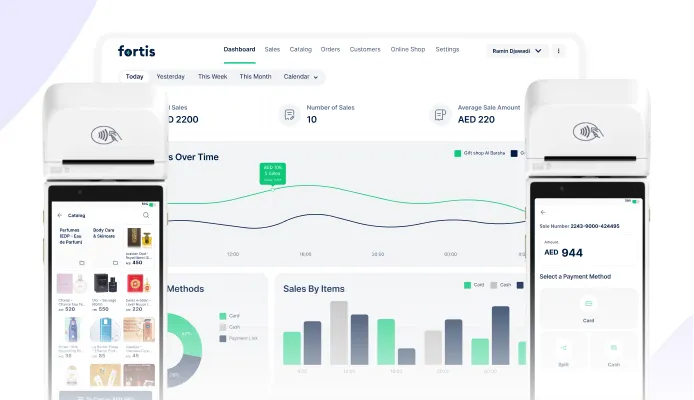
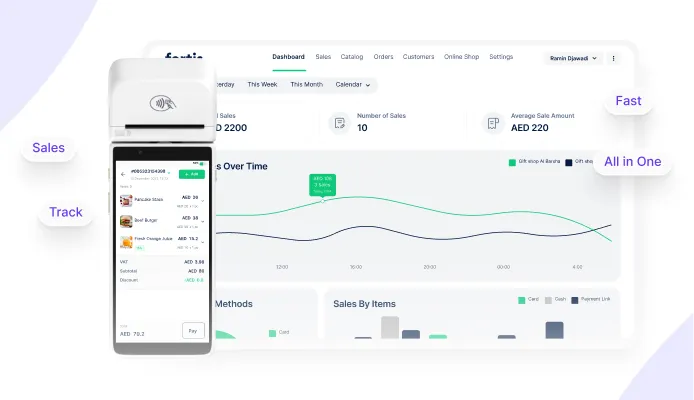
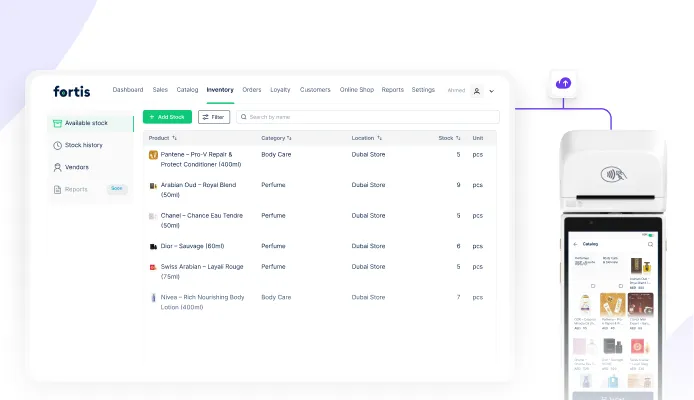
Fortis SmartPOS is a one stop solution that allows you to manage your business right from their card machine and online cloud platform. You can use the card machine to take orders, accept card and cash payments and also add customer information. With the online platform, you can get instant insights, track your sales, and manage your inventory.
The best part about our solution is that you can easily launch your own loyalty program within no time through two ways.
1. Launching Loyalty with Fortis POS
When using Fortis SmartPOS, the loyalty program is built directly into the checkout flow, which allows you to reward your customers directly from the card machine.
How integrated mode works
- Customers join via QR or you can add them to the loyalty program through the POS machine.
- Customers then receive a branded Apple/Google Wallet card.
- Cashiers simply enter the customer’s phone number at checkout.
- Earning is automatic after each paid sale.
- Redeeming is automatic too — points appear as a payment method on the POS.
2. Launching Loyalty Without Fortis POS (Standalone Mode)
If you are using any other POS other than Fortis SmartPOS, you can use our standalone app to launch your loyalty program. The process is pretty much the same except that you use our app to scan customers’ loyalty cards rather than the POS machine.
How standalone mode works
- You can create stamp or point-based loyalty cards with your branding, earn %, expiring and welcome bonus settings.
- Customers sign up the same way via QR + WhatsApp OTP.
- Staff use the scanner app to:
- Scan the customer’s wallet card
- Redeem points by applying an equivalent discount on their existing POS
How to Ensure the Success of Your Loyalty Program?
Let’s say you have launched your loyalty program, but how do you ensure that your customers enroll and it is actually successful. From talking to business owners and staff of various cafes and restaurants, we found out that the success of loyalty programs usually comes down to a few key principles.
1. Keep it extremely simple to explain
If staff need a long script to explain to your customers, it’s too complex.
For stamps:
“Every time you buy a coffee, we stamp your card.
When it’s full, your next coffee is free.”
For points/cashback:
“You earn points on every purchase.
1 point = 1 dirham. You can use them to pay next time.”
If customers “get it” in under 10 seconds, you’re on the right track.
2. Make rewards feel close, not distant
If you keep rewards too complex andtoo far away, people lose interest.
Good practice:
- First reward should be reachable in a week or a month of normal behavior
- Visible progress (number of stamps, points balance)
- Clear benefit (free item or meaningful discount)
3. Remove friction from enrollment
We all hate filling up long forms and sign up processes. So, it is important that you keep joining simple. The easier it is to join the program, the more people join.
Good ways:
- QR codes at the counter and on tables
- POS prompt: staff asks and enrolls the customer in a couple of taps
- Digital wallet cards that appear instantly after a scan
Try to avoid:
- Long forms
- Forced app downloads
- Asking for too much data upfront
You can always ask for more details later once trust is built.
4. Integrate loyalty into the checkout flow
Loyalty works best when it’s built into your existing payment process, not a separate afterthought.
For staff, that means:
- Seeing the customer’s loyalty status during checkout
- Automatically earning points on each order
- Redeeming points or validating stamps in one or two taps
If your team doesn’t have to think about it, usage goes up.
5. Talk about it, all the time
Even the smartest program fails if customers don’t know it exists.
Remind them:
- At the entrance (stickers, posters)
- On the menu or price board
- On receipts (“You earned 8 points today”)
- On social media (“Collect points — 1 point = 1 AED”)
At the counter, a simple line from staff helps:
“By the way, we have a loyalty program, you earn money back as points, 1 point equals 1 dirham. Want to join?”
6. Track what’s actually happening
To understand if your loyalty program is working, monitor:
- Enrollment rate – how many customers sign up
- Repeat rate – how often members come back vs non-members
- Average bill – did it increase after launching loyalty?
- Redemption behavior – are people actually using their rewards?
If people aren’t redeeming, the rewards might be confusing or too far away.
If too many points are redeemed too fast, you may need to adjust your earn rate or caps.
Final Thoughts
A loyalty program is the easiest way to increase your repeat customers and boost your revenue without even spending a dime on marketing. With Fortis loyalty program, you can launch your loyalty program within minutes and also track its success without any manual effort.